Tuesday, 23 July 2024

Differences between the 706 and 746

Now that i have both General Post Office 706 and 746 telephones in the collection, i thought it would be interesting to look at how these - at first glance identical - telephones differ. The 706 dialphone debuted in 1959 and soon became very popular. The 746 was an updated version of the telephone which arrived in 1967.

The main difference with these telephones is at the back of the case. The 746 has a built in recess which can be used as a carrying handle. Useful if you wish to look cool, walking around while on the telephone. Some 706s did have handles too but these were removeable (and probably losable).

Internally, the telephones were similar though the regulator, which was introduced with the 706 and could reduce the telephone's sensitivity if the telephone was affected by being too close to the telephone exchange (or other electromagnetic interference), was built into the circuitry and could not be removed unlike the 706.

In the photographs, the black telephone on the left is a 706L (the L meaning it had lettering around the dial - see exchange codes for the reason why) and the red on the right is a 746, modified to use the New Plan plug (so officially an 8746).


Tuesday, 16 July 2024

Changing a ribbon on a Leader II

Time for another ribbon change. My Silver-Reed Leader II is next on the list to receive a fresh ribbon, as it is a Seiko derived machine the process is fairly painless and just involves removing the old ribbon spools from their holders and lifting the ribbon from the machine. Then placing the new ribbon spools on the holders, making sure the hole is aligned with the prong so the ribbon will be advanced when you type. 

The only fiddly bit is making sure the ribbon is correctly threaded through the ribbon holder assembly so that when you type the type bar hits the ribbon and then the paper. I can happily report the Leader II now types nice and clearly again, in both colours.


Saturday, 13 July 2024

Carriage release

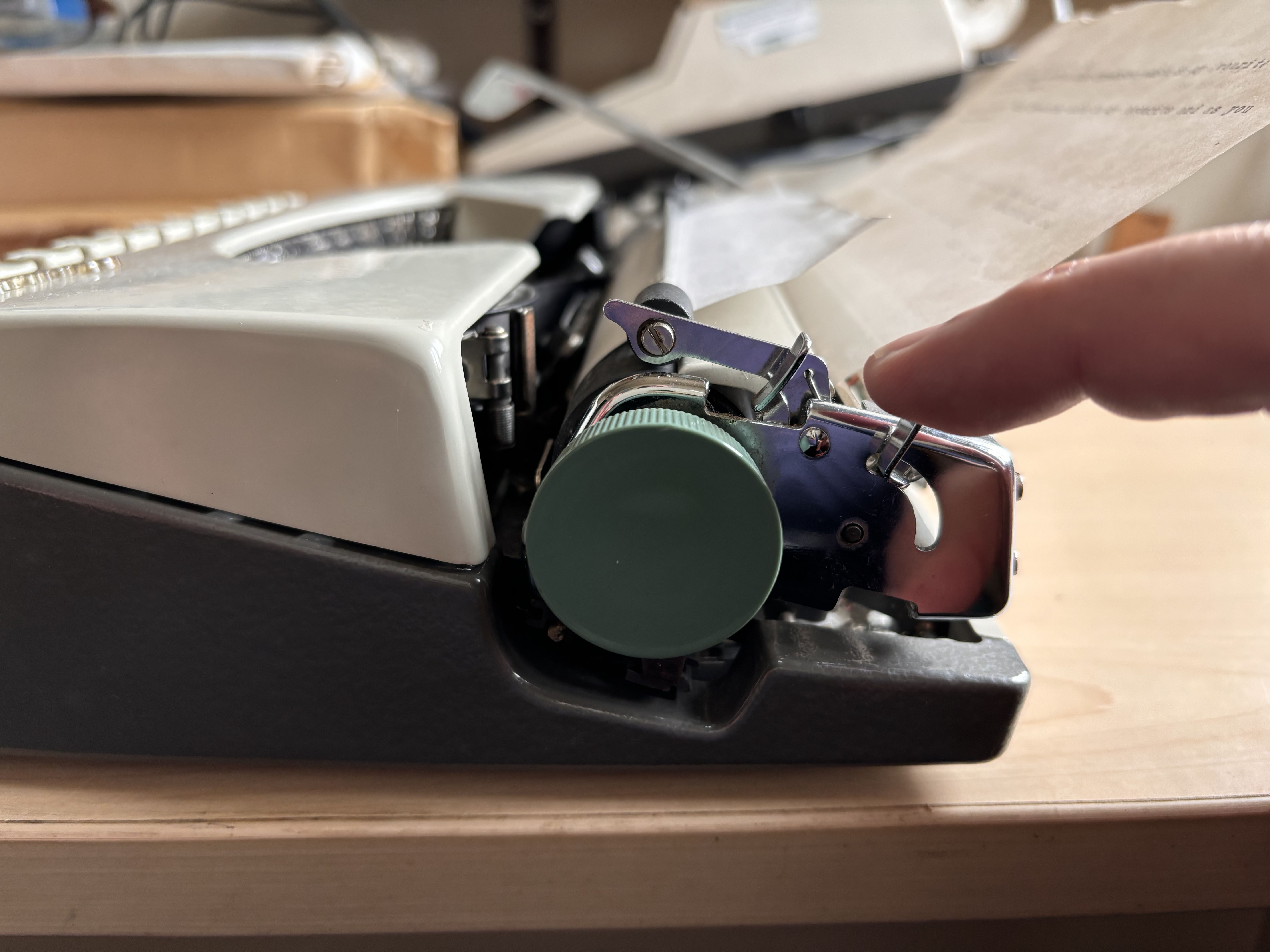
As you probably know, the carriage is the moving part of the typewriter. Every time you type a letter, the carriage will move a space to the left so the paper is in the right place for the next key strike. The carriage holds the paper in place using a roller. However, inserting the paper into the carriage and making sure it is straight is not the easiest thing in the world as the roller holds the paper tight.

Luckily most typewriters have a feature to help with this. The carriage release, usually a switch on the right side of the carriage, loosens the roller so you can slide the paper about to get it straight. Just don't forget to tighten it up again before you start typing!


Tuesday, 9 July 2024

GPO 706 dialphone

The General Post Office released it's 706 model telephone in 1959, a modernised version of earlier GPO telephones with inspiration taken from contemporary American designs. The 706, and it's later update the 746, remained in production for decades and can still be used today if retro-fitted with a New Plan BT socket.

One variant of the 706 was the 706L which had a lettered dial. This was useful in the age of letter coded telephone exchanges. Our example is a 706L.

The 706 was fitted with an optional regulator which could reduce the sensitivity of the telephone if the line was too close to a telephone exchange or even if the telephone was picking up interference from nearby strong radio transmissions. The 746 had this regulator built into it's circuitry.


Saturday, 6 July 2024

Showcase (15) : Olympus Olympiette

After the Brother 1350 which of course started the collection, this is my favourite typewriter in the collection. We are now into the 1980s and plastic is used more and more in typewriter construction. This is certainly the case with the Olympiette with it's beige moulded cover and dark grey keys.

So why do i love this typewriter so much, apart from the fact it types pretty well i love the fact it has London map stickers on it. It seems to me this was a typewriter that worked hard throughout it's life probably in some dingy office deep in London.


Tuesday, 2 July 2024

Royal Digital 5-M

It is the 1970s, established typewriter brands of course had to venture out into the exciting new world of the electronic calculator. This pleasing calculator was made in 1972 for the Litton Imperial Typewriter Company under it's Royal brand as the Royal Digital 5-M

The calculator had five functions, the four basic arithmetic functions and percentages thanks to algebraic logic, and also had memory. The calculator had an 8 digit green vacuum fluorescent tube display.


Saturday, 29 June 2024

Typing on the Maritsa

Latest machine in the collection.

Tuesday, 25 June 2024

Selling typewriters (3)

Some more adverts from public domain sources.


Saturday, 22 June 2024

Talking another telephone

The latest arrival in the collection of junk retro office equipment is this telephone. Now this may look like the dialphones i have already got but is in fact a GPO 706L! In future posts i will explain the differences between this and my 746s.


Tuesday, 18 June 2024

Busicom ribbon

My Busicom 1210PD is a fine desktop calculator with a working printer... well it made a noise anyway but because the ribbon was completely spent i couldn't be sure on that score. I have fitted a new ribbon to the calculator, a pretty simple operation to be honest and can happily report that the printer works very well. Black and red ink is available, and it also prints lozenges!


Saturday, 15 June 2024

Mysterious keys (11) : More margin-release variants

As we have seen earlier, there are a number of different ways which typewriter manufacturers denoted a key as being for margin-release, to let the margins be overrided. Here are two more variants.


The Triumph-Adler Tippa uses a simple double-ended arrow to show that the margins can be exceeded. A nice solution though perhaps some ambiguity for new users.


The Adsit Graduate though has decided to keep it as simple and straight forward as possible and just mark a key with M-R!

Tuesday, 11 June 2024

Typing on a Leader II

Typing on a Leader II, this video was recorded before the typewriter received a new ribbon, which will be documented here soon!

Sunday, 9 June 2024

Lloytron Accumatic 320

The latest calculator to join the collection is this jolly piece of beige and black. A Lloytron Accumatic 320 to be exact and it seems to work well with it's VFD display. The calculator is pretty feature rich with a few extra mathematical functions such as square roots to go along with the basic four arithmetric functions.


Tuesday, 4 June 2024

A look at the Maritsa 30

Let's take a look at the latest typewriter to join the collection, a Maritsa 30. It is a late 1980s machine with a plastic body. An unusual feature is that access to the ribbon requires removing two pieces of cover plate not one which is a bit of a faf. The typewriter is a good looking machine though, with a nearly new feel to it. The case is rather nice, making the typewriter look like an old microcomputer!

Operation wise it isn't bad. The keys are a little stiff but this may improve with more usage. The ribbon is nearly completely worn out, just a little bit of red ink remains. We will look to get a new ribbon later in the year.


Saturday, 1 June 2024

Desert island typewriters

I was thinking, if i was ever marooned to a desert island and could choose just three typewriters to take with me, what would i pick?

The Brother Deluxe 1350 would of course have to be the first pick. It was the first typewriter i ever bought and is still going strong, indeed it is one of the better machines in the collection.

Next would be my Olympia Olympiette, my favourite typewriter of all. It works pretty well (maybe not quite as good as some others i could choose) but there is no way i would not pick this machine for my exile.

So, those two picks were easy, what about the third? I think it needs to be a solidly built and reliable machine, which means one of the Silver-Reed type portables of which i have quite a few, including re-branded examples. So, the third typewriter i would take on my exile would be my Silver-Reed SEVENTY which is a superb little typewriter that still looks brand new.

So, what would you choose?


Tuesday, 28 May 2024

Pencils making the grade

Personally i always use a HB pencil (a Staedtler one natch) but what does HB actually mean? This code refers to the hardness of the pencil graphite. The grading (in Europe at least, the US and elsewhere use different grade classification schemes) runs from at least 9B - which are the softest pencils - useful for artwork shading - through to 9H or beyond - these are so hard they can puncture holes in plate armour. B stands for Blackness and H for Hardness. There is also an F which is between HB and H in hardness, the F refers to the fact the graphite can be sharpened to a fine point.

This code has been used since the early 19th century. However, there is no standard for pencil hardness. HB or 2H from one manufacturer might be slightly different to another manufacturer. I find the Staedtler HB suits my purposes perfectly, as you would expect from a grade which is right in the middle!


Sunday, 26 May 2024

Commodore 887D

This is a typical mid-1970s calculator, and can be compared to the Commodore 776M also in the collection. The 887D is a very similar calculator in many ways though noticably wider. 

That extra girth allowed for an eight digit red LED display. The calculator was powered by a Commodore GRBP-89 CPU. As well as the four standard operations and percentage the calculator also had an Exchange key (EX) which reversed an operation. My 887D still has it's box, though fairly worn. The box has kept the calculator in good condition though.


Tuesday, 21 May 2024

SEVENTY update

An updated video of me typing on my Silver-Reed SEVENTY typewriter.

Saturday, 18 May 2024

Operator?

Before new fangled digital telephone exchanges, people had to have their calls connected by hand. Telephone exchanges would have teams of switchboard operators (usually women as men were found to not have the patience and personal skills to deal with the general public!)

The operator had a high panel in front of them with rows and rows of female jacks (holes basically). When a telephone user made a call then one of the lamps above a jack would light up. The operator would insert a plug into the jack to speak to the caller and find out whom they wanted to call. The operator would then insert another plug into one of the other jacks to complete the circuit and allow the call to be made. 

Although this worked well it did not scale and was quickly overwhelmed by demand, especially in big cities were there were soon thousands of telephone lines by the early 1900s. Automatic exchanges began operating in Britain in 1912 though the last manual exchanges were not turned off until the 1960s, and continued in use on a smaller scale in internal business switchboards for longer.

Below are two examples of this kind of exchange switchboard seen in the Birmingham Museum collection.


Wednesday, 15 May 2024

Why these paper sizes?

Whether you use A4 paper in your typewriter, or - as God intended - quarto, the question remains: why are paper sizes... well this size? The answer to this (well in the case of US 8.5 x 11 inch paper anyway) lies in the history of how paper was made. In the early days of paper making it was largely done by hand. Workers dipped paper mold frames into vats of wood pulp. Once dried, the wood pulp in the frames was now a sheet of paper. It was found that frames which were forty-four inches wide were best for the workers to handle with their outstretched arms.

Each 44 inch sheet was folded into four to give four eleven inch wide sheets of paper. Naturally use of the typewriter and later printing technologies helped to standardise paper sizes but basically it is largely down to how long people's arms are!